Showing posts with label energy. Show all posts

Wednesday, May 30, 2012

Mazimeru Hydro Power Plant inaugurated

Another of the hydro projects I was working on in Rwanda in 2006-2009 finally goes into operation. More importantly, the project vindicates private sector promotion as a way of developing the energy sector.

Good work CARERA, ADENYA and GIZ....


http://newsofrwanda.com/ibikorwa/8838/nyaruguru-district-prime-minister-commends-private-ownership-hydro-power-plant/

"“Do you see how state-owned companies differ from privately-owned ones?”, ... were [the] Prime Minister’s first words at Nshili hydro power plant, ... criticizing the slow-paced activities at Nshili hydro power plant – which is state-run "


Sunday, February 05, 2012

Businesspeople

Gregory Tayi and Olivier Ngororabanga coordinated one of the micro-hydropower projects GIZ supported whilst I was coordinating the project there in 2006-2009. It was a great pleasure and privilege to work with both of them. Gregory was interviewed a few months ago by the BBC: http://www.bbc.co.uk/news/world-africa-15695209. It's a charming interview:

The main capital one has is oneself; to know what one wants and where one wants to go.
...
Money is not what makes the [business]person. ... [Business] is making life easier for others.


At the inauguration of the REPRO micro-hydropower plant in 2010

Sunday, July 27, 2008

Big Concrete Thingy

(It's a sediment separator of a micro-hydro power plant belonging to the Rwandese company, REPRO.)

Sunday, March 30, 2008

Stephen keeps it real (video)

My friend and former work colleague, Stephen Forder, explaining global warming on the South African youth-oriented show, "Keeping it Real". Nicely done, Stephen.


The original post is on his website, cognition.co.za.

Monday, January 28, 2008

Sustainable Development for dummies (Part 3 – The way forward)

This is the third of 3 blog posts in which I try to explain very briefly my view of what “Sustainable Development” is, based on my experiences in Rwanda.

In my last post, I concluded:

Development Aid is sustainable when it leaves behind an independent and exponentially growing sector, that continues to grow and respond to future environmental, social and economic challenges.

So how do we create such independent exponential growth? Experience in creating sectors in Europe and Africa have shown that to “jump-start” a sector from the outside, you need to work through 3 development stages:


To illustrate this development, you could look at the development of the German solar energy market from the 1990s up until now. This market started with a small demonstration programme called “100 roofs”, then it the government introduced an even larger “1000 roofs” programme and finally the government introduced a law guaranteeing a fixed price for solar electricity to private and public operators. The solar electricity market took off and is now one of the largest solar energy markets in the world.

This model shows a logical progression, in which each stage prepares for the next one: Pilot projects in phase 1 test technologies and methods that could be used in a larger national programme in phase 2; Larger national programmes in phase 2 sensitise the population and create independent organisations, institutions and companies for phase 3. Finally, the independent sector development on a national level in phase 3 can create the exponential growth required for sustainable development.

A poorly designed development aid project would be one that counter-acts this development. For example, if a country has a growing private textiles industry (phase 3) and a donor brings in free clothes to distribute to the poor (phase 1), then this will damage or even destroy the local clothes and textiles businesses.

Sustainable development is hard to achieve. It is unclear whether such a complicated issue is within the abilities of a large, bureaucratic, inflexible and uncoordinated donor industry. Time will tell: If in the next 50 years we achieve as little development in Africa as we have in the last 50, we will once again have failed.

Wednesday, December 05, 2007

Pouring concrete


A visit to one of our micro-hydro plant building sites. On days like this I love my job. These are project profit-driven private sector companies with restricted support from us. They are employing dozens of locals, developing spin-off businesses, will provide cheap electricity and are already looking for the next possible power plants. This is sustainable development. No community-owned plant with financial management issues, buraucracy and misguided ideas about the public good.

Tuesday, August 14, 2007

The stone crusher with the pink hat

Rwandan fashion is a fusion of European clothes donations and an African love of bright colours.

These guys are crushing stones that they sell as construction material to one of our on-going micro-hydro projects here.

Monday, June 18, 2007

The problem with Africa's biggest solar power plant

I was at the inauguration of Africa’s biggest solar plant on the 6th July.

The work of the German companies Stadtwerke Mainz, Juwi and my friend Jutta in completing this plant is impressive. With 250kW it may be small compared to conventional power plants, but huge for solar power. This project broke new ground in Rwanda.


The press was unquestioningly positive.

Unfortunately, I think this project is misguided for a couple of reasons:
  • This is a large grid-connected plant. The future of solar energy in Rwanda is small household systems. This project demonstrates how not to do solar projects in Rwanda. The 250kW contribution to the grid of about 50 000kW is minimal. If the 250kW had instead been installed as 2500 household systems, the impact would have been much larger.
  • The plant was built entirely by German companies with German financing. The amount of technology and skills transfer is minimal.
  • The plant is a donation that makes no commercial sense. It demonstrates the technical possibilities of solar power, but not its economic viability. It is the economic viability that will decide about the future of solar energy in Rwanda.
  • Such non-commercial projects destroy local markets by suppressing prices to artificially low levels. Commercial energy projects in all sectors are being held back by unrealistically low cost expectations in the country.
I hope that future projects in Rwanda are better designed to develop the Rwandan private sector. Only if Rwandans themselves learn how to develop projects and commercial ventures can this country develop out of poverty.

Friday, February 09, 2007

Singapore of Central Africa?

On a development blog NextBillion, there were recently a couple of articles on Rwanda. 2 that I left comments on are "Toward Rwanda" about the ambition of developing Rwanda as the "Singapore of Central Africa" and another article about the prioritisation of electricity.

Sunday, December 10, 2006

Privatisation in Rwanda

This will probably only be of interest to Rwanda-philes and energy sector people. But the FT published a very interesting article on the privatisation of Rwandan utilities.

Working on the development of small private sector companies in the energy sector, I am very much aware of the painfully slow privatisation process in the energy sector. My comments on this are also on the World Bank's Private Sector Development Blog:

"Privatisation has to be about more than selling off state assets. It needs to be as much about transparent regulation and stimulating competition. The telecoms sector in Rwanda is still lacking much-needed competition. As for the lack of progress in the energy sector, this sector could move ahead even whilst Electrogaz' privatisation is paralysed by its high generation costs. But for this, Rwanda would need to introduce clear regulation that opens the way for private sector investors to challenge the poor levels of delivery of Electrogaz' defacto (but no longer legal) monopoly."

Friday, May 26, 2006

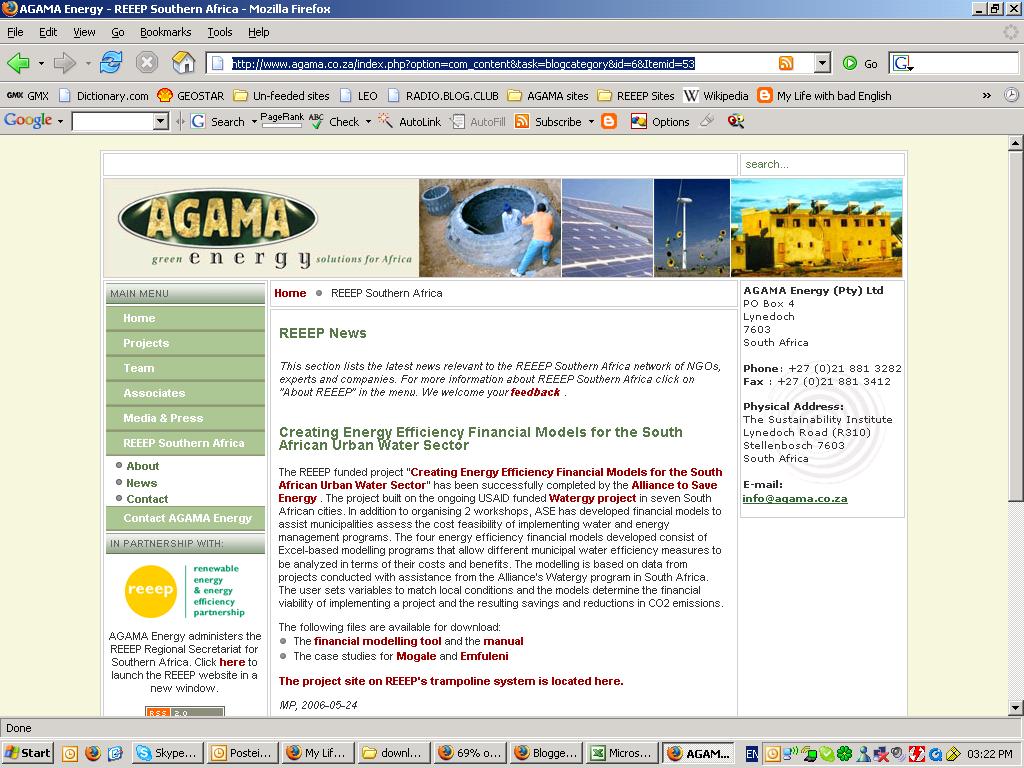
www.agama.co.za/reeep

This will probably only be interesting to other renewable energy people: but I have been working on a new REEEP web presence (including a news feed) at www.agama.co.za/reeep . Some of my first experiments in web page programming ;-)

Wednesday, May 24, 2006

Kuyasa

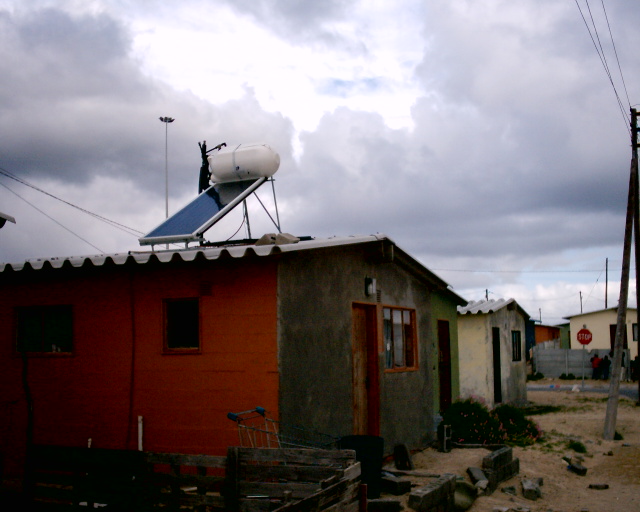
These are pictures from a solar water heating project that Agama did some time ago in Kuyasa, a township near Cape Town. The next project is searching for funding...

Thursday, May 11, 2006

Who farted?

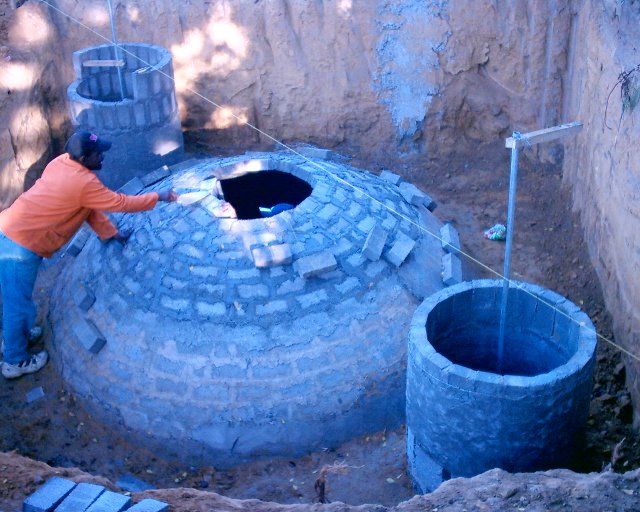
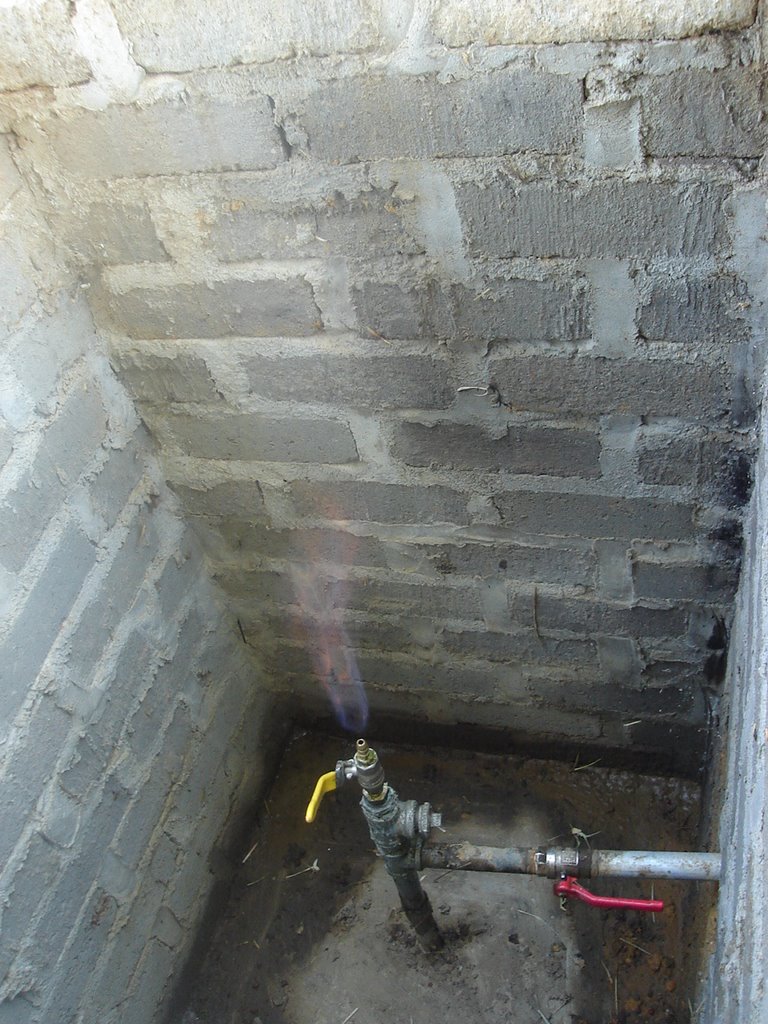
David's bad joke about the biomethane plant reminded me that there is a biomethane plant sitting just 30 metres from my office. Only it runs off someone else's excrement. This is the inlet (sewage pipes from 2 toilets and a bunch of organic waste), the dome is where the fermentation / gasification business happens (you can't actually see it now, because it is buried underground), and the last picture is what comes out: clean natural gas. Now how cool is that. Better than trying to light a fart.


Tuesday, April 18, 2006

Some thoughts

Not having taken any good pictures recently, I guess it is time to write a bit.

I seem to be spending alot of time worrying about the South African energy sector these days. South Africa is going through interesting times. The Western Cape is going through "load shedding"- which is basically just planned power cuts - and people are asking where South Africa's power for the next few decades of growth is going to come from. The organisation that I represent (REEEP) is getting involved in a lot of lobbying work down here - so I'm getting my share of meetings with bone-headed utility managers, ministry officials and all sorts of businessmen.

But enough work. Life is still good down here. I'm beginning to get more of a feel for the place. South Africa has a hell of a long way to go before becoming Mandela's rainbow nation, but it also isn't the crime capital of the world that many people paint it to be. The city centres are multi-cultural and multi-ethnic in a way that European cities can only dream of. The townships are far from the centres of crime and violence that is often protrayed by some South Africans and even travel guides. This is where the developed world is forced to live door-to-door with the developing world.

Europe is truly boring by comparison ;-)

Maurice